
For years, the idea of luxury has been synonymous with opulence, exclusivity and extravagance.
But today, luxury is changing its skin. More and more high-end brands are responding to a growing question: can luxury and sustainability coexist?
The answer is not only yes — it is necessary.
The new face of luxury: awareness and authenticity
Luxury consumers are no longer seeking status and prestige alone, but also values and meaning.
Growing awareness around climate change, human rights and social justice is redefining the very concept of exclusivity.
The “new luxury” is no longer measured only in price or rarity, but in a brand’s ability to meet ethical and environmental expectations.
Who is leading the transformation?
The 2024 Altagamma–Boston Consulting Group study captures a sector in full transformation, where consumer behaviours are reshaping the priorities of the luxury market.
The sustainability revolution in luxury is being driven by several key players:
Consumers – One of the most significant segments is the “Beyond Money” group: individuals who no longer purchase simply to own, but to express values, perspectives and social commitment.
This segment holds enormous influence: with an annual average spend of €350,000 and a share that has doubled in the last decade, it now holds 66% of global financial wealth.
A crucial audience that demands authenticity, transparency and sustainability as the new symbols of exclusivity.
Companies – Sector leaders like Kering and LVMH are investing in raw-material traceability, emissions reduction and sustainable materials. Other brands excel in the treatment of VICs (Very Important Customers), offering exclusive and highly personalised experiences.
Governments and regulators – The European Union has introduced regulations such as the extended producer responsibility directive for the textile sector and the anti-deforestation law.
NGOs and global movements – Organisations including Greenpeace and Fairtrade continue to push for more ethical supply chains.
This evolution is evident in the initiatives of many luxury brands that are redefining what luxury means.
Sustainable luxury in practice: who is already leading the way?
Stella McCartney – A pioneer in sustainable fashion, using recycled and vegan materials, completely avoiding leather and fur.
Prada – With the Re-Nylon line, the brand transforms fishing nets and plastic waste into ECONYL® regenerated nylon, aiming to replace all virgin nylon.
Gucci – Fur-free and committed to sustainable production practices, proving that ethics and aesthetics can coexist.
Burberry – Investing in sustainable materials, recycling initiatives and reduced environmental impact.
Veja – Footwear made with organic cotton, recycled plastic and wild rubber, with a strong focus on transparency.
Pangaia – Known for innovative materials like seaweed fibre and organic cotton, and eco-friendly packaging.
Mara Hoffman – Uses green fabrics such as Tencel and Econyl, along with environmentally respectful production processes.
Collina Strada – New York label producing recycled and local materials to minimise impact.
Carmina Campus – Founded by Ilaria Venturini Fendi, combining traditional luxury values with ethical responsibility by creating unique accessories from recycled materials.
Eileen Fisher – Timeless design grounded in organic and recycled materials.
This shift reflects not only sustainable practices, but also commitments to social innovation, human rights and greater accessibility.
When luxury rewrites the rules of social impact
(Carousel section 1–10 omitted in translation, to be inserted visually as in original.)
The 10 major sustainability trends in luxury
The luxury industry is being reshaped by innovative models centred around sustainability. Here are the main trends:
- Circular luxury – Recycling and reuse strategies, such as Gucci Vault and Prada Re-Nylon.
- Innovative, green materials – Stella McCartney’s plant-based leather and regenerated Econyl.
- Electrification and tech innovation – Bentley and Rolls-Royce are developing luxury electric models.
- Digital craftsmanship and blockchain – LVMH uses blockchain to certify material origin.
- Experiential sustainability – Eco-friendly luxury experiences, like those offered by Six Senses resorts.
- Waste reduction – Zero-waste processes in luxury fashion production.
- Second-hand and rental – LVMH’s investments in platforms like Vestiaire Collective.
- Regenerative luxury & wellness – Experiences that regenerate both the environment and personal wellbeing.
- Inclusivity and social impact – Luxury brands increasingly adopting diversity and human-rights policies.
- Long-lasting, multifunctional design – Durability as the new standard of excellence.
Luxury that strengthens the bottom line
Sustainability is not only an ethical imperative — it is a business opportunity.
According to BCG–Altagamma 2024, the “Beyond Money” segment continues to grow at 10% per year.
Moreover, 72% of Italians believe companies should take a stance on environmental and social issues.
The shift toward sustainable and conscious luxury is not just a trend — it is being rewarded by the market.
Some examples:
Hermès – In 2025, Hermès surpassed LVMH to become France’s most valuable luxury company, with a market cap of €248 billion. This was achieved despite overall sector slowdown, proving the strength of a strategy focused on craftsmanship, quality and sustainability.
Gucci – Under Marco Bizzarri, sales grew from €3.9 billion in 2015 to €9.6 billion in 2019. The brand became carbon-neutral across operations and supply chain in 2018.
Burberry – Now carbon-neutral across global operations and targeting climate-positive status by 2040. Investments include sustainable sourcing and training design teams in responsible practices.
Zegna – Its shift toward sustainable, casual elegance helped revenues reach €1.5 billion in 2022. The brand has adopted renewable energy and personalised, sustainability-focused styling services.
Ralph Lauren – Growth in China driven by a strategy combining the brand’s American heritage with strong sustainability commitments.
These cases show that integrating sustainability into corporate strategy not only meets rising consumer expectations but also leads to competitive advantage and measurable economic growth.
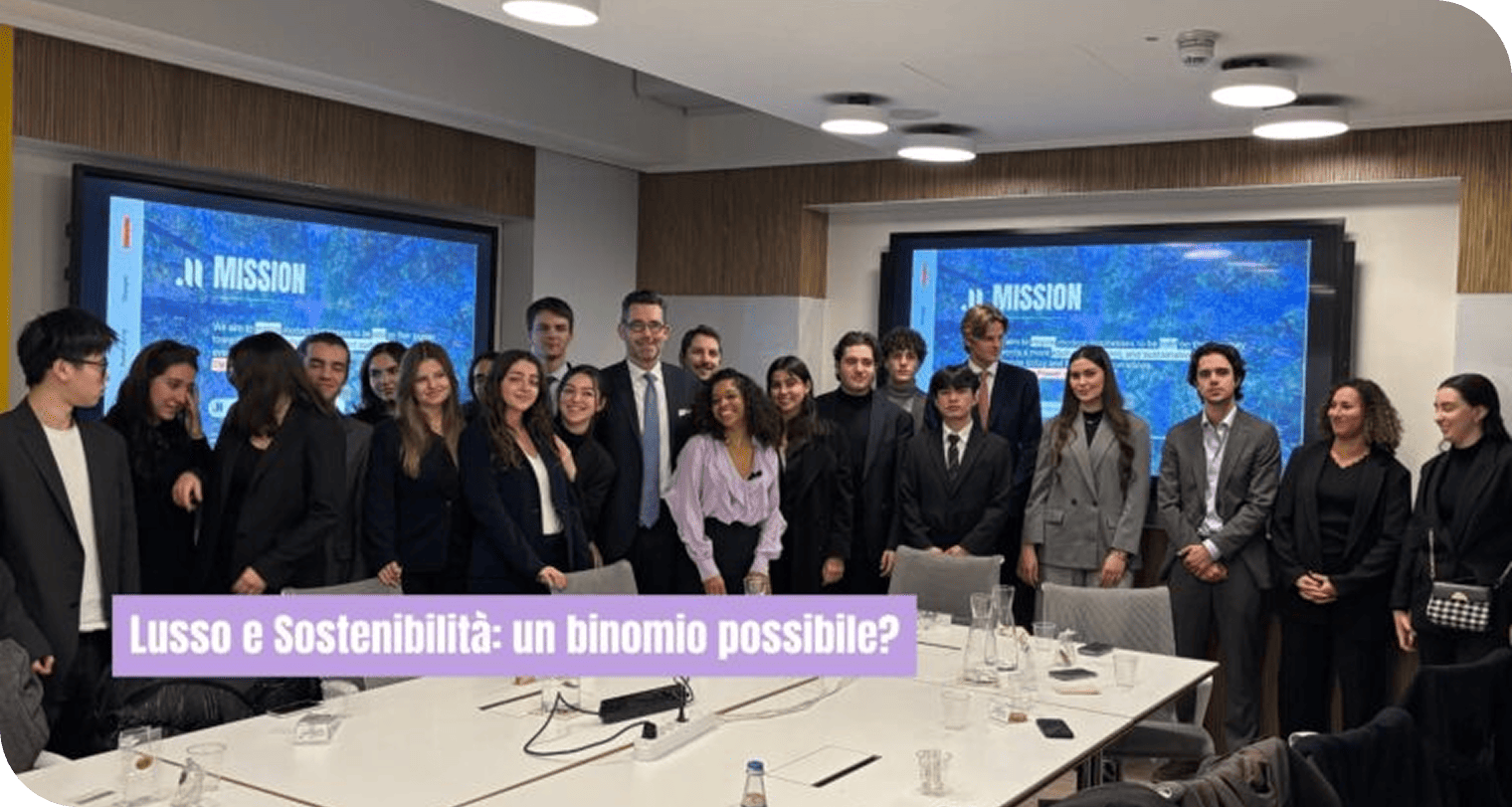
Innovamey’s commitment: the February 2025 eventIn February 2025, Innovamey took part in a special event dedicated to the future of sustainable luxury.
Together with 50 international students from the Master in Luxury Management at Glion Hospitality School, we explored the new frontiers of sustainability in the industry.
Two days of discussion, inspiration and big questions: where is luxury heading to meet the new demands of the market?
We analysed the potential of blockchain to ensure traceability of artworks and raw materials, the evolution of green and zero-waste resorts, the electric revolution and sustainable yacht design. A particular focus was placed on the social impact of supply chains, including human rights, inclusion and accessibility.
The event was made possible thanks to the collaboration with BCG Italy and Paolo Gamba, President of Assonautica Lombardia, who enriched the discussion with strategic insights.
Can luxury and sustainability coexist?
We believe they can.
And engaging with the next generation reminded us how essential it is to keep asking questions — even when answers are not immediate.
Our point of view
Sustainability is not an option — it is a strategic growth lever for companies, including those in the luxury sector.
The future of luxury must embrace inclusion, transparency, care for the planet at every step of the value chain and responsible innovation.
That is why we support companies on their transformation journeys, helping them integrate sustainability into their business models and communicate this commitment authentically.
The challenge of sustainable luxury is not just about materials or emissions — it is cultural.
It is about crafting a luxury that creates value for everyone.
A luxury that is beautiful, but also just.
The new normal?
We are witnessing a revolution in which exclusivity and responsibility can coexist.
The question is no longer “can we afford to do this?”
but rather,
“can we afford to ignore it?”
Companies that rise to this challenge will not only win tomorrow’s consumers — they will shape the very future of luxury.
About Innovamey
Innovamey transforms sustainability into a real engine of growth, supporting companies in designing sustainable strategies, transforming business models and communicating with impact.
We innovate products and services by placing sustainability at the centre, developing solutions that combine progress, responsibility and competitiveness.
We don’t just imagine the future — we build it.
We collaborate with leading academic institutions such as Bocconi University, Università Cattolica and the Glion Institute of Higher Education to train tomorrow’s leaders and develop innovative strategies grounded in real cases and discussion with new generations.
For us, sustainability is not just a goal — it is an evolving process: a dynamic balance between innovation, positive impact and growth requiring vision, action and constant adaptation.
We have supported major organisations in redesigning processes to create positive, business-driven impact — from evolving products and services for a more sustainability-conscious market, to building operations that attract and empower talent who care about people, the planet and profitability.
We help organisations develop a sustainable culture through training and conscious leadership, supporting them in communicating their transformation authentically so that sustainability becomes a lived and shared reality.
We have been key contributors at major events such as Climate Tech (IKN), Ethical HR (Team Different) and Global Inclusion (Il Sole 24 Ore), helping define strategies that unite economic progress with social and environmental responsibility.
Innovamey is action, impact and transformation.
We build with companies a future where sustainability means innovation, value and conscious growth.
Because change is not told — it is made.