
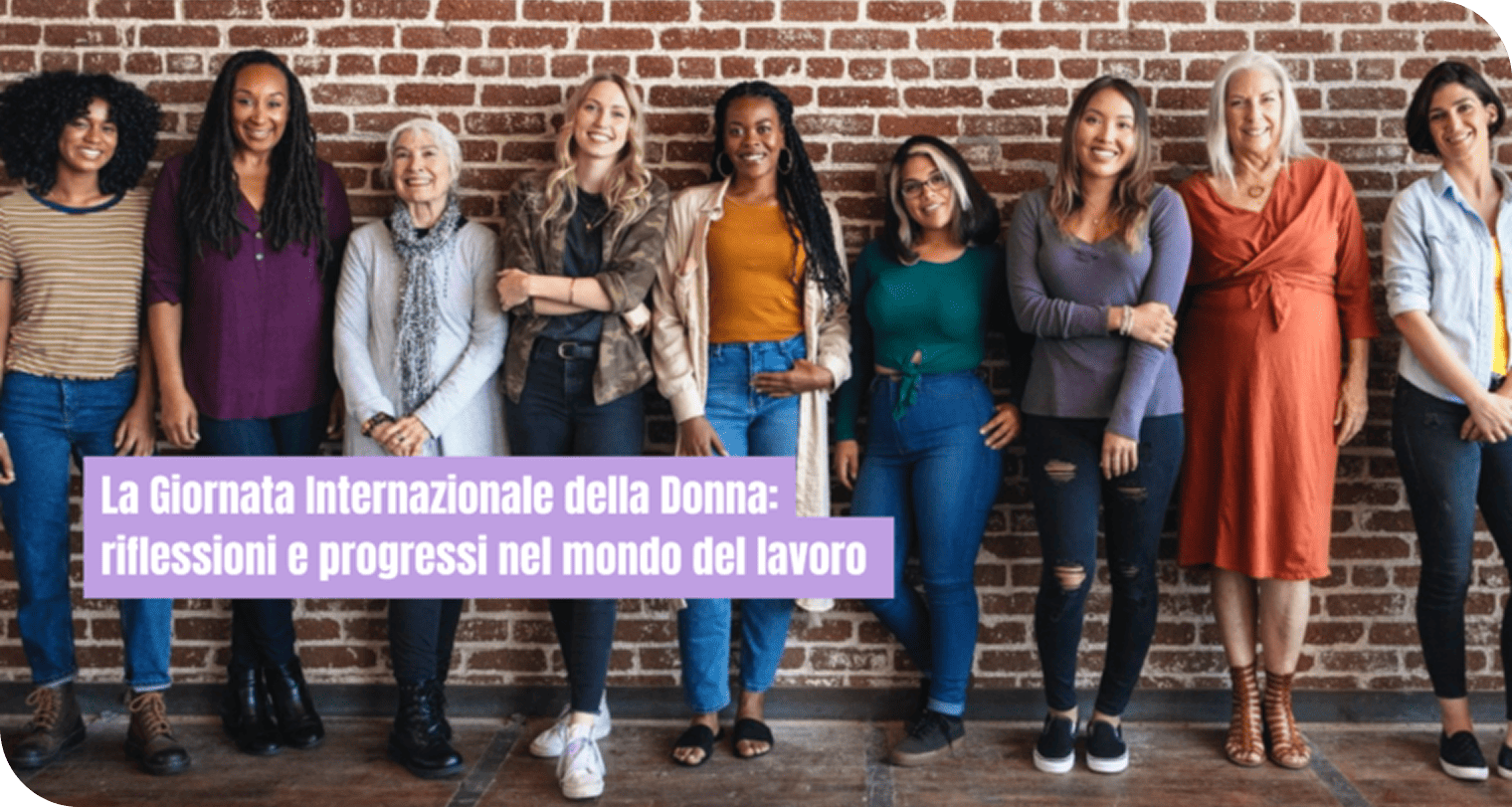
March 8th is not just a symbolic date — it is a moment of awareness and action.
We celebrate women’s achievements, but we also reflect on the challenges that still prevent true gender equality.
In the workplace, in society, in institutions: are we truly ready to ensure women have the same opportunities and rights as men?
Despite the progress made, the road ahead is still long.
Deep inequalities remain — from the gender pay gap to the difficulty of balancing career and family life, to gender-based violence, which remains an unacceptable social scourge.
Gender Pay Gap: a divide that is still far too deep
How much is a woman’s work worth compared to a man’s?
In 2022, the gender pay gap in Italy stood at 5.6%, but the disparities become alarming in specific groups:
– 16.6% among university graduates
– 30.8% among executives
(source: ISTAT)
If we look at the average annual earnings, the gap reaches 43%, placing Italy among the worst-performing European countries.
Why does this happen?
The reasons are many: fewer career opportunities, higher female presence in lower-paid sectors, limited access to leadership roles. And still, a system that too often penalises motherhood, treating it as an obstacle rather than a value.
Can we truly speak of progress if a woman still has to fight to earn a fair salary?
Italy continues to fall behind in the race toward gender equality.
According to the Global Gender Gap Report 2024 by the World Economic Forum, the country ranks 87th out of 146, with a score of 0.703 out of 1. This marks a drop of eight places in a single year — a sign of worrying stagnation in closing gender disparities.
Yet signs of progress exist.
During an interview, Karen Nahum, General Manager for Publishing and Digital at Il Sole 24 Ore, shared the important steps the Editorial Group has taken toward gender equality.
Economic participation: a critical weakness
Only 70.1% of women in Italy are active in the labour market, yet their presence in leadership roles remains limited, and the pay gap persists.
It is no surprise that Italy ranks 95th globally for pay equality.
The most discouraging figure concerns women’s employment:
with a rate of 56.5% among women aged 20–64, Italy is last in Europe.
The gap is enormous when compared to Germany (77.4%) and France (71.7%).
This raises an urgent question:
How much longer will women have to wait for real change?
Entrepreneurship as a response
“Some women choose to turn challenges into enterprise, talent into opportunity, and obstacles into empowerment.
For me, entrepreneurship is a powerful solution.
It is the chance to transform talent and passion into something real, without waiting for anyone’s permission.
It means taking your future into your own hands and giving space to your ambitions.
It is an act of freedom: to create, to innovate, to play your part.”Aram Mbow – Founder, Innovamey
Work–life balance: an impossible equation?
Career or family?
For many women, this still feels like a forced choice.
Even though the issue affects all parents, the burden still falls disproportionately on women.
Why?
– Lack of adequate support services
– A deeply rooted cultural expectation that domestic work is “women’s work”
– Low workplace flexibility
All these factors make work–life balance incredibly fragile.
The consequences?
Fewer career opportunities, more part-time contracts (often not by choice), and a constant race against time to make everything fit.
“Every day feels like a race against the clock: work, children, home.
I often wonder if I’m doing enough, if I’m doing it right.
I try to keep everything balanced, without letting guilt take over when something slips or when perfection fades.
We shouldn’t have to choose; we shouldn’t have to give up.
We need more support, more flexibility, more awareness.”Sara Todde – Sustainability & Innovation Content Strategy Manager
Gender-based violence: an unacceptable reality
It is 2025, and yet the number of women victims of violence continues to rise.
In 2024, Italy recorded 113 femicides, most committed by partners or family members (source: AP News).
These are not just numbers — they are lives cut short, dreams interrupted, constant fear.
In 2024, warnings for stalking increased by 44%, and those for domestic violence by 126% (source: Ministry of the Interior).
These figures say one thing clearly: violence against women is not an emergency — it is a structural problem.
Can we call ourselves a civil society if so many women still fear for their safety inside their own homes?
We also discussed this on November 25th, with Aram Mbow, during the International Day for the Elimination of Violence Against Women.
A step forward: femicide recognised as a separate crime
In response to this emergency, the Italian government recently approved a bill introducing the autonomous crime of femicide, punishable by life imprisonment (source: Il Fatto Quotidiano).
This is an important signal: gender-based violence is finally recognised as a phenomenon requiring a strong and specific legal response.
But will a new law be enough to stop the tragedy?
Surely not.
We need cultural change, concrete actions to protect victims, and preventative measures.
We need a social shift built on respect and equality.
Towards a more equal future: small steps, big hope
Despite the challenges, signs of progress are emerging.
In 2024, 36% of managers in Italy were women, surpassing the Eurozone average for the first time (source: Eurostat).
More companies are adopting inclusive policies and promoting pay equity. Awareness is growing.
But is it enough?
If we want to build a truly fair society, we must continue fighting for inclusive policies, equal workplaces, and a world where being born a woman does not mean starting from behind.
March 8th: a day to reflect — and to act
International Women’s Day must not be only a celebration.
It should be a moment to ask ourselves:
What can we do to truly change things?
We must keep talking about equality, demanding concrete action, and building a future where no woman has to fight for what she is rightfully owed.
Gender equality is not a favour — it is justice.
About Innovamey
Innovamey transforms sustainability into a true engine of tangible growth, supporting companies in designing sustainable strategies, transforming business models, and communicating impact authentically.
We innovate products and services by placing sustainability at the centre, developing solutions that combine progress, responsibility, and competitiveness.
We don’t just imagine the future — we build it.
We collaborate with prestigious academic institutions such as Bocconi University, Università Cattolica, and the Glion Institute of Higher Education to train tomorrow’s leaders through real cases and dialogue with new generations.
For us, sustainability is not just a goal — it is an evolving process: a dynamic balance between innovation, positive impact, and growth that requires vision, action, and adaptation.
We have supported major organisations in redesigning their processes for positive, business-driven impact — from evolving products and services for an increasingly sustainability-conscious market, to building operations designed to attract and empower talent who care about people, planet, and profitability.
We help organisations build a sustainable culture through training and conscious leadership and support them in communicating their transformation authentically, so that sustainability becomes a lived and shared reality.
We have been key contributors at major events such as Climate Tech (IKN), Ethical HR (Team Different), and Global Inclusion (Il Sole 24 Ore), shaping strategies that unite economic progress with social and environmental responsibility.
Innovamey is action, impact, and transformation.
We build, together with companies, a future where sustainability means innovation, value, and conscious growth.
Because change is not spoken — it is made.