
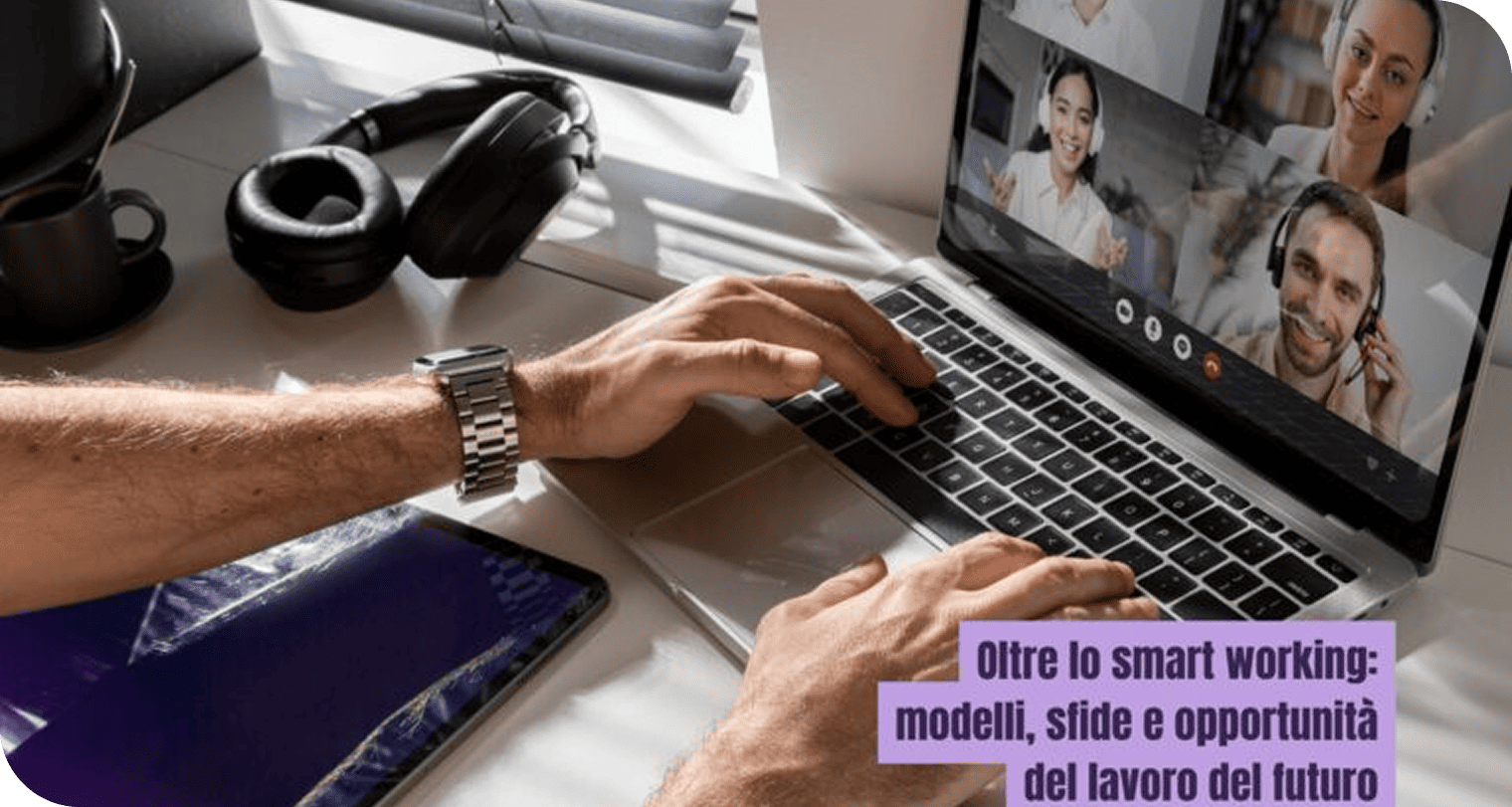
August 2025: Work Reinvents Itself
In the 1970s, the idea of working from home was unthinkable: the office was the only socially acceptable place to carry out professional activities.
Only with the rise of the internet and high-speed connections did the concept of flexible work gradually become plausible.
But it was Covid-19 in 2020 that triggered a rapid and radical transformation: workers around the world experienced remote working firsthand, proving that multiple workplaces do not equate to lower productivity.
Global, European and Italian Overview
In 2020, according to the International Labour Organization, more than 40% of workers in high-income countries worked fully remotely for at least a significant period.
In the following years, fully remote work declined while hybrid work gained momentum as a balanced, sustainable model.
In Europe, Eurofound reports a decline in fully remote workers from 24% in 2022 to 14% in 2024, while 44% of European workers now operate in hybrid mode.
In Italy, the Politecnico di Milano’s Smart Working Observatory estimates 3.55 million smart workers in 2024, with a projected 5% increase in 2025 to reach 3.75 million.
Large enterprises are leading the shift: 96% have structured hybrid policies, and nearly 2 million employees alternate between home and office.
In the public sector, around 500,000 people work remotely, with several administrations planning to expand adoption.
SMEs, meanwhile, count roughly 520,000 smart workers — a figure that remains stable with no clear signs of growth.
Beyond Smart Working: The New Frontiers of Work
The 2025 landscape goes far beyond traditional smart working. It includes a set of innovative modalities designed to balance productivity and wellbeing:
- Workation: combining work with stays in tourist destinations — coastal towns, mountain refuges or art cities.
Italian favourites include Genoa, Catania, Florence, Bari and Palermo. Towns like Santa Fiora and Montepulciano offer coworking spaces, discounts and tailored programs for digital nomads. - Four-day week: reducing the workweek to four days with full pay.
Italian companies such as EssilorLuxottica (15,000+ employees involved), Intesa Sanpaolo and Mondelez are already experimenting.
Several public administrations are testing 36-hour, 4-day schedules on a voluntary basis. - Flexitime: employees structure their working hours freely as long as objectives and minimum coverage moments are met.
- Job Sharing: two professionals share one role and related responsibilities.
A model that enables balance without stepping away from operational positions. - Structured digital nomadism: working from another country for months, with full fiscal, legal and organisational support.
Italy introduced the Digital Nomad Visa in April 2024, aimed at highly skilled non-EU workers with a minimum income of €28,000, health insurance and prior remote work experience. - Quality gig economy: specialised, well-paid micro-projects based on advanced skills — an evolution of the classic “gig work”.
- Hub & Spoke: a central office supported by satellite hubs or local coworking spaces to reduce commuting and maintain strong organisational ties.
- Async-first: asynchronous communication (documents, messages, recorded videos) instead of real-time meetings — ideal for distributed teams.
- Blended work: humans collaborating with AI for analysis, drafting and automation, shifting human tasks towards strategy, creativity and problem-solving.
All these models share the same principle:
work adapts to people — not the other way around.
Flexibility: A Criterion for Choosing a Job
Research from 2024–2025 shows:
- Over 70% of Italian smart workers would not accept a fully in-person job.
- Many would consider changing jobs — or request a significant salary increase — to give up flexibility.
- For nearly 50% of workers, flexibility matters more than a higher salary.
Five Best-Practice Examples of Companies Redefining Work
TeamSystem (Italy)
Through its TeamSystem Next initiative, the company offers up to 80% smart working and allows employees to adopt a self-managed four-day week through “Light Friday”.
Intesa Sanpaolo (Italy)
The first major Italian banking group to test a four-day week on a voluntary basis (36 hours across 4 days), plus up to 120 smart working days per year.
Employees working from home also receive meal vouchers.
EssilorLuxottica (Italy)
Introduced a short week for 15,000–20,000 employees, offering 20 Fridays off per year with full salary.
The plan aims to improve wellbeing, efficiency and inclusion.
Bee / Growens (Italy–Europe)
A Southern-Italy-focused remote-work company.
56% of its Italian workforce operates from small towns in the Mezzogiorno, supporting local revitalisation and distributed talent models.
The company also founded the Cagliari Innovation Lab to invest in regional innovation.
Grenke (Italy / European multinational)
Uses an integrated hub-and-spoke model with local coworking spaces, sustainable ergonomic equipment for remote work, and one mandatory in-office day per week — improving productivity, satisfaction and retention.
YOTTAWORLD: Flexibility as Company Culture
Among positive examples in Italy, YOTTAWORLD stands out for an approach that goes far beyond internal policies.
Supported by Innovamey through a sustainability-driven Business Innovation path, YOTTAWORLD treats work flexibility not as a benefit, but as an integral part of its organisational culture.
As Giulia Scanu, HR Manager at YOTTAWORLD, explains:
“During our journey with Innovamey, we discovered that for us, flexibility has never been just a policy — it has always been part of our human-centred culture.
It means trusting people, giving them autonomy, and at the same time creating real moments of connection.
Flexibility has brought us concrete benefits in wellbeing, engagement and team satisfaction.”
One of these moments is FridaYotta — a monthly gathering dedicated to company updates and informal time together, reinforcing cohesion beyond work tasks.
“The biggest challenge is balancing autonomy with organisational alignment.
Effective communication is essential, and constant dialogue helps keep connection and transparency alive.”
— Giulia Scanu
This model illustrates how organisational innovation can coexist with human connection, maintaining high engagement even in distributed work environments.
How We Work at Innovamey: Structured Flexibility in Summer
At Innovamey, work follows a mixed model that values both collaboration in person and focused remote work.
During most of the year:
- 3 days per week are office-based for collaboration and brainstorming
- 2 days are remote for individual tasks and greater autonomy
In summer, those who wish can work from different locations:
Sara chooses Sardinia, Sharon alternates between sea and mountains, Aram divides time between Sicily and Milan, and Marija works from Montenegro with her family.
As the team shares:
- Sharon: “Smart working gives us precious hours for training, passions and family, but office days keep human connection alive.”
- Sara: “Being in the office generates ideas and energy, while remote days help balance private life.”
- Aram: “Home-office silence is ideal for deep focus, but in-person meetings are irreplaceable for creativity and team spirit.”
- Marija: “This freedom is not a benefit — it is a form of respect for our real lives.”
Conclusion
From the rigid, fully in-person work of the 1970s to the flexible, diverse and rich ecosystem of 2025, the transformation is complete.
Hybrid work is now consolidated across Europe and Italy, but the future is shaped by new models: workation, four-day week, structured nomadism, async-first practices, and blended work with AI.
Today, the real challenge for companies is not adopting smart working — but designing work models that truly respond to people’s needs, offering autonomy, wellbeing and self-management.
In August 2025, workers choose where, how and when they operate.
Innovamey shows that work can be both flexible and deeply engaging.
About Innovamey
Innovamey transforms sustainability into a real engine of growth, supporting companies in designing sustainable strategies, transforming business models and communicating impact.
We innovate products and services by placing sustainability at the centre, developing solutions that combine progress, responsibility and competitiveness.
We don’t just imagine the future — we build it.
We collaborate with leading academic institutions such as Bocconi University, Università Cattolica and the Glion Institute of Higher Education to train tomorrow’s leaders through real cases and intergenerational learning.
For us, sustainability is not just a goal, but an evolutionary process — a dynamic balance between innovation, positive impact and growth that requires vision, action and constant adaptation.
We have supported major organisations in redesigning their processes with a positive-impact, business-driven approach — from evolving products and services for sustainability-minded markets to building operations that empower talent committed to people, planet and profitability.
We help organisations create sustainable culture through training, conscious leadership and authentic communication, ensuring sustainability is not only a target but a lived reality.
We have played a key role in major events such as IKN’s Climate Tech, Team Different’s Ethical HR and Il Sole 24 Ore’s Global Inclusion, contributing to strategies that unite economic progress with social and environmental responsibility.
Innovamey is action, impact and transformation.
We build with companies a future where sustainability means innovation, value and conscious growth.
Because change is not told — it is made.